
Collagen microcontact prints enable multiplexed assays in organotypic brain slice:
Professor Christian Humpel and his team at the Medical University of Innsbruck, Austria have developed a practical, imaging‑friendly platform that brings precise spatial control to living brain slices. Working with 150‑micrometer organotypic mouse slices cultured at the membrane interface, they preserve native three‑dimensional circuitry while applying localized biochemical cues. This approach lets the group study neuronal outgrowth, microglial activation, and vascular behavior in a single manipulable ex vivo system, and it reduces animal use by enabling multiple experimental conditions from the same brain.
Their workflow combines microcontact printing with a collagen‑based hydrogel to create narrow lanes or defined dot patterns of proteins on semipermeable membranes. PDMS stamps cast from silicon wafer masters (made by GeSiM) transfer collagen loaded with a single molecule of interest—such as NGF, GDNF, MCP‑1, polyornithine, or human plasma—onto the membrane surface, and the slices are placed directly on those prints. Over days to weeks, cholinergic or dopaminergic axons extend along NGF‑ or GDNF‑printed lanes, microglia migrate toward MCP‑1 or plasma‑derived cues, and endothelial elements reorganize or extend along collagen‑based prints, all while the tissue remains accessible to inverted fluorescence and live imaging. The collagen matrix provides both a physical guide and a gradual release mechanism, making the method adaptable to guidance, migration, and localized exposure experiments.
Across several papers from the group, these patterned interfaces have produced reproducible, biologically meaningful outcomes. Cholinergic and dopaminergic fibers grow into aligned bundles along their respective trophic factor prints, and newly formed nerve fibers can be monitored with live‑cell dyes or calcium indicators on compatible “ring‑insert” systems [1, 6]. Microglia migrate along MCP‑1‑loaded prints or respond differentially to human plasma from Alzheimer’s patients [4, 5], and endothelial cells labeled with laminin or lectin can be tracked over weeks as they reorganize or respond to growth factors such as FGF‑2 [2, 3]. The team has also used the platform to explore translational questions, linking tissue‑level responses to candidate plasma biomarkers [3, 5] and framing the system as a step toward a brain‑on‑a‑chip that integrates neuronal, immune, and vascular readouts [4].
Our technology provides several key elements of this work: the high-resolution master molds and PDMS stamp fabrication, the imaging compatible membranes and inserts, and the reproducible pattern transfer that allow tens of micrometer in size to guide cellular behavior reliably. There are practical constraints to note: collagen prints degrade over weeks, very fine features require careful fabrication, and most studies use postnatal tissue that is more plastic than adult brain. Even so, Humpel’s lab has shown that microcontact printing applied to organotypic slices provides a compact, reproducible platform for mechanistic experiments, live functional readouts and translational studies.
Looking ahead, the combination of patterned collagen prints and organotypic slices offers clear potential to accelerate discovery and reduce reliance on whole‑animal studies. By enabling spatially resolved perturbations and longitudinal imaging in intact tissue, the platform can help bridge mechanistic neuroscience and biomarker research, and it provides a practical foundation for brain‑on‑a‑chip systems that integrate neuronal, immune, and vascular dynamics.
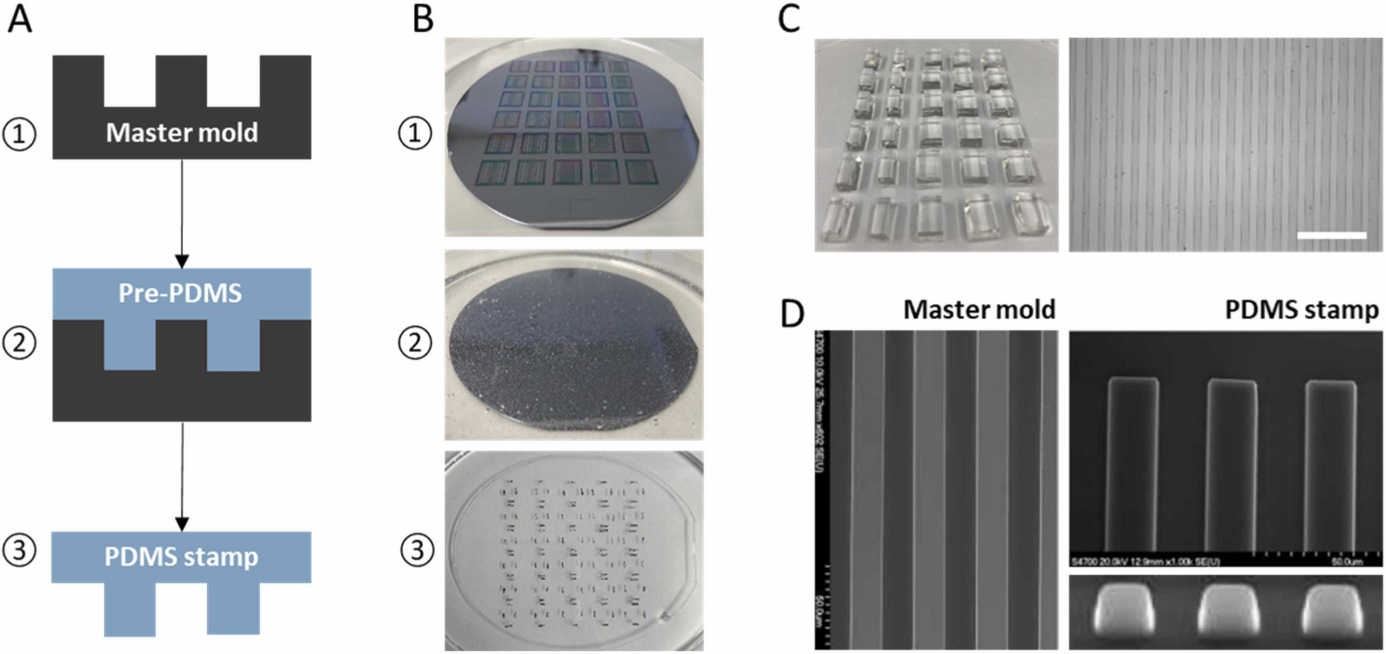
Steiner & Humpel, J. Neurosci. Methods, 2023, Fig. 1. Generation and characterization of polydimethylsiloxane (PDMS) stamps.
This article is based on publications from Professor Christian Humpel’s group:
- Microcontact Printing of Cholinergic Neurons in Organotypic Brain Slices. Frontiers in Neurology (2021). DOI: 10.3389/fneur.2021.775621.
- Long‑term live‑cell imaging of GFAP+ astroglia and laminin+ vessels in organotypic mouse brain slices using microcontact printing. Frontiers in Cellular Neuroscience (2025). DOI: 10.3389/fncel.2025.1540150.
- Novel Plasma Biomarkers for Alzheimer’s Disease: Insights from Organotypic Brain Slice and Microcontact Printing Techniques. Frontiers in Bioscience‑Landmark (FBL) (2025). DOI: 10.31083/FBL36257.
- Long‑term organotypic brain slices cultured on collagen‑based microcontact prints: A perspective for a brain‑on‑a‑chip. Journal of Neuroscience Methods 399 (2023) 109979. DOI: 10.1016/j.jneumeth.2023.109979.
- From Organotypic Mouse Brain Slices to Human Alzheimer Plasma Biomarkers: A Focus on Microglia. Biomolecules 14(9):1109 (2024). DOI: 10.3390/biom14091109.
- Organotypic mouse brain slices: low-cost “ring-inserts” to study cholinergic and dopaminergic neurons with live cell imaging with an emphasis on calcium imaging. Biofunctional Materials 2025(2):0011. DOI: 10.55092/bm20250011.